Wednesday, October 20, 2010

New Data Contradicts Mayan Calendar End Date


The Mayan Long Count calendar likely doesn’t end on December 21, 2012  ~ the date hyped by many apocalyptic thinkers ~ according to new research into the technique for translating the ancient calendar into Gregorian calendar years.

The research also contends that the actual end date of the Mayan calendar is essentially unknown within at least a 100-year span. In fact, the Mayan calendar may have already ended.

According to LiveScience:
A new critique, published as a chapter in the new textbook Calendars and Years II: Astronomy and Time in the Ancient and Medieval World (Oxbow Books, 2010), argues that the accepted conversions of dates from Mayan to the modern calendar may be off by as much as 50 or 100 years. That would throw the supposed and overhyped 2012 apocalypse off by decades and cast into doubt the dates of historical Mayan events. (The doomsday worries are based on the fact that the Mayan calendar ends in 2012, much as our year ends on Dec. 31.) 
The Mayan calendar was converted to today's Gregorian calendar using a calculation called the GMT constant, named for the last initials of three early Mayanist researchers. Much of the work emphasized dates recovered from colonial documents that were written in the Mayan language in the Latin alphabet, according to the chapter's author, Gerardo Aldana, professor of Chicana and Chicano Studies at the University of California.
Later, the GMT constant was bolstered by American linguist and anthropologist Floyd Lounsbury, who used data in the Dresden Codex Venus Table, a Mayan calendar and almanac that charts dates relative to the movements of Venus.
"He took the position that his work removed the last obstacle to fully accepting the GMT constant," Aldana said in a statement. "Others took his work even further, suggesting that he had proven the GMT constant to be correct." But according to Aldana, Lounsbury's evidence is far from irrefutable.

Click here for the complete article.

Thursday, October 14, 2010

Unknown Bronze Age Civilization is Discovered

Site ancient settlement high in Caucasus Mountains.

Researchers have discovered traces of a previously unknown Bronze Age civilization in the peaks of Russia's Caucasus Mountains, using aerial photographs taken 40 years ago.

"We have discovered a civilization dating from the 16th to the 14th centuries BC, high in the mountains south of Kislovodsk," Andrei Belinsky, the head of a joint Russian-German expedition that has been investigating the region for five years, told AFP.

He said researchers had discovered stone foundations, some up to 3.3 feet high, at nearly 200 sites, all "visibly constructed according to the same architectural plan, with an oval courtyard in the centre, and connected by roads."

The decorations and forms of bronze items found in the area indicate the civilization is linked to the Kuban civilization, which was discovered at the end of the 19th century at the foot of Mount Kazbek and is known for its artistic bronze works.

Click here for the complete PhysOrg.com article.

Wednesday, October 6, 2010

Far From Brutes, Neanderthals Had Compassion

Neanderthal reconstruction in Prehistoric Museum of Halle, Germany.

New research indicates Neanderthals displayed “a deep seated sense of compassion” and were not the dumb brutes often depicted in archaeological lore.

“Compassion is perhaps the most fundamental human emotion,” researcher Penny Spikins of the University of York tells Discovery News. “It binds us together and can inspire us but it is also fragile and elusive. This apparent fragility makes addressing the evidence for the development of compassion in our most ancient ancestors a unique challenge, yet the archaeological record has an important story to tell about the prehistory of compassion."

Based on fossils, artifacts and other evidence, the scientists propose a four-stage model for the development of human compassion:
The first stage began six million years ago, according to the scientists, when the common ancestor of humans and chimpanzees experienced the initial awakenings of an empathy for others and motivation to help them, perhaps with a gesture of comfort, or moving a branch to allow them to pass.
The second stage from 1.8 million years ago sees compassion in Homo erectus beginning to be regulated as an emotion integrated with rational thought. Care of sick individuals represented an extensive compassionate investment while the emergence of special treatment of the dead suggested grief at the loss of a loved one and a desire to soothe others feelings, the researchers conclude.
The third stage, based on findings from Europe between around 500,000 and 40,000 years ago, sees humans such as Homo heidelbergensis and Neanderthals developing deep-seated commitments to the welfare of others illustrated by a long adolescence and a dependence on hunting together. There is also archaeological evidence of the routine care of the injured or infirm over extended periods. These include the remains of a child with a congenital brain abnormality who was not abandoned, but lived until five or six years old. The researchers also note that there was a Neanderthal with a withered arm, deformed feet and blindness in one eye who must have been cared for, perhaps for as long as twenty years.
In the fourth stage, the scientists say modern humans starting 120,000 years ago extended compassion to strangers, animals, objects and abstract concepts. 
“We have traditionally paid a lot of attention to how early humans thought about each other,” Spikins adds, “but it may well be time to pay rather more attention to whether or not they ‘cared.’”

Click here for the complete Discovery News article.

Monday, October 4, 2010

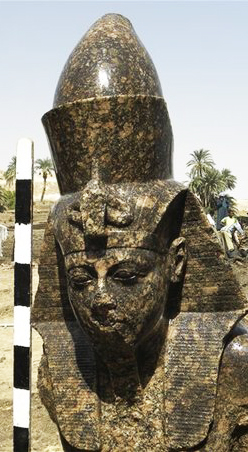
Rare Statue of Amenhotep is Unearthed

Part of a statue of King Amenhotep III, believed to be King Tutankhamun’s grandfather, has been unearthed, Egypt's Ministry of Culture announced on Saturday. 
The 4-by-3-foot red granite statue depicts the Egyptian pharaoh wearing the double crown of Egypt, which is decorated with a sacred asp. The king is seated on a throne next to the Theban god Amun.

The ninth ruler of the Eighteenth Dynasty, Amenhotep III (1390-1352 B.C.), reigned for 38 years during a time when Egypt was at the height of prosperity and cultural development. His mummy was found in 1898 in a tomb dubbed KV35 by French Egyptologist Victor Loret.

The statue is one of the best new finds in the area because of its expert craftsmanship," according to Zahi Hawass of the Supreme Council of Antiquities (SCA), said in a statement.

Click here for the complete article.

Friday, October 1, 2010

New Report Dispels Clovis Comet-Destruction Theory


There simply is no evidence that a comet created a cataclysm that wiped out the Clovis people, the earliest known culture in North America, according to two archaeologists who have studied the situation.

Archaeologists David Meltzer of Southern Methodist University and Vance Holliday of the University of Arizona argue that there is nothing in the archaeological record to suggest an abrupt collapse of Clovis populations.

“Whether or not the proposed extraterrestrial impact occurred is a matter for empirical testing in the geological record,” they write in the October issued of Current Anthropology magazine. “In so far as concerns the archaeological record, an extraterrestrial impact is an unnecessary solution for an archaeological problem that does not exist.”

According to PhysOrg.com:
The comet theory first emerged in 2007 when a team of scientists announced evidence of a large extraterrestrial impact that occurred about 12,900 years ago. The impact was said to have caused a sudden cooling of the North American climate, killing off mammoths and other megafauna.
It could also explain the apparent disappearance of the Clovis people, whose characteristic spear points vanish from the archaeological record shortly after the supposed impact. As evidence for the rapid Clovis depopulation, comet theorists point out that very few Clovis archaeological sites show evidence of human occupation after the Clovis. 
At the few sites that do, Clovis and post-Clovis artifacts are separated by archaeologically sterile layers of sediments, indicating a time gap between the civilizations. In fact, comet theorists argue, there seems to be a dead zone in the human archaeological record in North America beginning with the comet impact and lasting about 500 years.
But Meltzer and Holliday argue that a lack of later human occupation at Clovis sites is no reason to assume a population collapse. “Single-occupation Paleoindian sites ~ Clovis or post-Clovis ~ are the norm,” Holliday said. That's because many Paleoindian sites are hunting kill sites, and it would be highly unlikely for kills to be made repeatedly in the exact same spot.

Click here for the complete article.
More discussion of the issue on Anthropology.net blog.

Thursday, September 30, 2010

Early Roman Temple to Mithras Discovered in France

Early depiction of Mithras killing a bull.
Archaeologists excavating at Angers, France, have discovered the remains of a temple ~ dating to the third century AD ~ dedicated to the Indo-Iranian god Mithras. In the temple sanctuary, a typical bas-relief of the god Mithras wearing his Phrygian cap shows him slaughtering a bull ~ the so-called tauroctony. The depiction was intentionally damaged in ancient times, possibly by early Christians trying to suppress the pagan cult.

According to the London Independent:
The earliest evidence of occupation at the 9,000 square meter excavation site is dated to about 10 BC. It is believed the cult of Mithras was brought to the Roman Empire by soldiers coming from the East at the end of the first century AD.
Mithraism, a religion exclusive to men, first became popular with the elite, but quickly spread through all layers of society. Later it became known as a soldier's cult. Shrines dedicated to Mithras are most often found at the borders of the Roman Empire, where large amounts of troops were stationed. 
With the rise of Christianity, the worship of Mithras came under severe attack. Roman Emperor Theodosius banned the Mithriac mysteries in 392, along with all other pagan religions.

Click here for the complete article.

Tuesday, September 28, 2010

Aborigines May Have Been First to Settle Americas

Australian Aborigines on Botany Bay by Arthur Phillip, 1790.

Scientists now say there is compelling evidence that two different populations first colonized the Americas, the earliest being Australian Aborigines over 11,000 years ago.

Cranial features distinctive to Australian Aborigines are present in hundreds of skulls uncovered in Central and South America, according to evolutionary biologist Walter Neves of the University of São Paulo.

The second population to arrive ~ up to now regarded as the first migration to the Americas ~ was humans of East and North Asian origin who entered the Americas from Siberia across the Bering Strait and founded modern Native American populations, he argues. It has been believed that these Asian people spread steadily southward to eventually populate Central and South America as well.

“The results suggest a clear biological affinity between the early South Americans and the South Pacific population,” Neves says. “This association allowed for the conclusion that the Americas were occupied before the spreading of the classical Mongoloid morphology in Asia.”

According to Cosmos magazine:
Until about a decade ago, the dominant theory in American archaeology circles was that the 'Clovis people' ~ whose culture is defined by the stone tools they used to kill megafauna such as mammoths ~ was the first population to arrive in the Americas. 
They were thought to have crossed the Bering Strait from Siberia into Alaska at the end of the last Ice Age, some 10,000 or so years ago, following herds of megafauna across a land bridge created as water was locked up in glaciers and ice sheets.
But in the late 1990s, Neves and his colleagues re-examined a female skeleton that had been excavated in the 1970s in an extensive cave system in Central Brazil known as Lapa Vermelha. Dubbed Luzia, the skeleton is between 11,000 and 11,400 years old. “We believe she is the oldest skeleton in the Americas,” Neves said.

Click here for the complete article.
Sunday, September 26, 2010

Pyramid "Grid" May Be Key to Construction

Bryn's drawings may unlock pyramid's construction secrets.

According to a Norwegian architect, researchers have been so preoccupied by the weight of the stones comprising Egypt’s ancient pyramids that they’ve overlooked two major problems: How did the Egyptians know exactly where to put the enormously heavy building blocks, and how was the master architect able to communicate highly precise plans to a workforce of 10,000 illiterate men?

These were among the questions that confronted Ole J. Bryn, an architect and associate professor of Architecture and Fine Art with the Norwegian University of Science and Technology when he began examining Khufu's Great Pyramid in Giza. Khufu's pyramid ~ better known as the Pyramid of Cheops ~ consists of 2.3 million limestone blocks weighing roughly 7 million tons. At 146.6 meters high, it held the record as the tallest structure ever built for nearly 4,000 years.

According to ScienceDaily:
What Bryn discovered was quite simple. He believes that the Egyptians invented the modern building grid, by separating the structure's measuring system from the physical building itself, thus introducing tolerance, as it is called in today's engineering and architectural professions.
Bryn has studied the plans from the thirty oldest Egyptian pyramids, and discovered a precision system that made it possible for the Egyptians to reach the pyramid's last and highest point, the apex point, with an impressive degree of accuracy. By exploring and making a plan of the pyramid it is possible to prepare modern project documentation of not just one, but all pyramids from any given period.
As long as the architect knows the main dimensions of a pyramid, he can project the building as he would have done it with a modern building, but with building methods and measurements known from the ancient Egypt, Bryn says.
If the principles behind Bryn's drawings are correct, according to ScienceDaily, then archaeologists will have a new "map" that demonstrates that the pyramids are not a "bunch of heavy rocks with unknown structures" but, rather, incredibly precise structures.

Click here for the complete article.

Tuesday, September 21, 2010

King Herod's Private Theater Box is Located

Frescos found in the once-extravagant theater in Herod's palace.

Archaeologists in the Judean desert have excavated a lavish, private theater box in King Herod's winter palace. The room provides further proof of Herod’s thirst for extravagance, say the archaeologists from Hebrew University in Jerusalem.

Herod was ruler of the Holy Land under Roman occupation from 37 to 4 B.C. He is known for his extensive building throughout the area, including the 400-seat theater where his private box was found.

Herod commissioned Roman artists to decorate the theater walls with elaborate paintings and plaster moldings around 15 B.C. Upper portions feature paintings of windows overlooking a river and a seascape with a large sailboat.

Click here for the Associated Press article.

Monday, September 20, 2010

Another 37 Ancient Tombs Found Near Pellas

Greek archaeologists last week announced discovery of 37 ancient tombs dating back to the Iron Age in a cemetery near the ancient Macedonian capital of Pellas.

Discoveries at the site included a bronze helmet with a gold mouthplate (shown at right), weapons and jewelry in the tomb of a warrior from the 6th century BC.

The newly discovered tombs brings the total to about 1,000 tombs ~ dating from 650 BC to 280 BC ~ discovered in the area since archaeological work began in 2000. The tombs contain iron swords, spears and daggers, as well as vases, pottery and jewelry of gold, silver and iron.

Sunday, September 12, 2010

Temple to Athena Nike Now Restored

The temple during the restoration process.

The Greek temple of Athena Nike on the Acropolis is now fully restored, following a decade-long facelift. Built between 427–424 B.C. ~ while Athens was fighting Sparta for control of the Greek world ~ the building was dedicated to the city's patron goddess Athena in her capacity to bring victory in battle.

 According to the Associated Press, the compact temple survived intact until the late 17th century, when it was demolished to provide material for a gun emplacement. It was rebuilt after Greece's independence from Ottoman rule in 1829.
Athena Nike had two dates with restoration crews over the last two centuries — one in 1935, another in the 1830s — and the latest top–to–bottom refurbishment was aimed to fix mistakes from previous restoration efforts for good. 
"We have used the latest technology, following successful experimentation with stress and aging," project head Dionysia Mihalopoulou told the Associated Press. "The choice and use of materials was the best possible, they will not corrode." 
Starting in 2000, workers took down 315 marble sections weighing up to 2–1/2 tons, laying bare a concrete foundation slab that was replaced by a stainless steel grid. Crews replaced the concrete additions with sections of new marble from ancient quarry sites ~ whose brilliant white contrasts with the old stone's patina in places like the walls and columns to make clear they are modern additions. 
Every block was returned to the original position selected by the temple's ancient architects.

Click here for the Associated Press article.

Thursday, September 9, 2010

Tetracycline Found in Ancient Nubian Mummies

Ancient Egyptian depiction of royal beer drinking.

Africa’s ancient Nubians were using the antibiotic tetracycline 2,000 years ago, likely obtaining it in the beer they had consumed since early childhood. Large doses of the drug ~ which was officially patented in the United States in 1950 ~ have been found in mummies dating back to 350 AD.

According to Discovery News:
Some of the first people to use antibiotics, according to the research, may have lived along the shores of the Nile in Sudanese Nubia, which spans the border of modern Egypt and Sudan.
“Given the amount of tetracycline there, they had to know what they were doing,” said co-author George Armelagos, a biological anthropologist at Emory University in Atlanta. “They may not have known what tetracycline was, but they certainly knew something was making them feel better.” 
Armelagos was part of a group of anthropologists that excavated the mummies in 1963. His original goal was to study osteoporosis in the Nubians, who lived between about 350 and 550 A.D. But while looking through a microscope at samples of the ancient bone under ultraviolet light, he saw what looked like tetracycline -- an antibiotic that was not officially patented in modern times until 1950.
At first, he assumed that some kind of contamination had occurred.
“Imagine if you're unwrapping a mummy, and all of a sudden, you see a pair of Ray Ban sunglasses on it,” Armelagos said. “Initially, we thought it was a product of modern technology.”
Scientists were able to trace the source of the antibiotic to grain that was contaminated with a type of mold-like bacteria called Streptomyces. Grains that are stored underground can easily become moldy with Streptomyces contamination, though these bacteria would only produce small amounts of tetracycline on their own when left to sit or baked into bread. Only when people fermented the grain would tetracycline production explode.

Nubians both ate the fermented grains as gruel and used it to make beer.

Click here for the Discovery News article.