Showing posts with label DNA. Show all posts

Sunday, February 16, 2014

Clovis DNA Points to Native-American Origins

The genetic sequence from a prehistoric baby in a 12,000-year-old Clovis burial site in Montana is providing significant data on the origins of the earliest Americans. Until now, archaeologists have had to rely mainly on tools made of stone and bone, and other artifacts to tell the story of human migration about 15,000 years ago to the New World.

Now that story is bolstered with some dramatic, ancient DNA, extracted from the remains of a 1-year-old boy who died in what is now Montana more than 12,000 years ago, according to a study described in Nature magazine.
"Clovis is what we like to refer to as an 'archaeological complex,' " says Michael Waters, an archaeologist at Texas A&M University.
That complex is defined by characteristic tools, he says.  
The Clovis artifacts were common for about 400 years, starting about 13,000 years ago. But at this point, there is only one set of human remains associated with those sorts of tools: that of the baby from Montana. "So this genetic study actually provides us with a look at who these people were," Waters says.
The most obvious conclusion from the study is that the Clovis people who lived on the Anzick site in Montana were genetically very much like Native Americans throughout the Western Hemisphere.

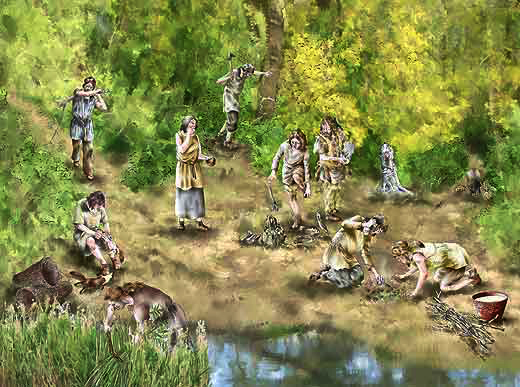
Image: Depiction of Clovis people, Mastodon State Park, Missouri


Saturday, June 11, 2011

Farming Came to Europe by Varied Routes


How agriculture reached Europe from its origins in the Middle East some 11,000 years ago has remained a tantalizing mystery for scientists. Now a new DNA-based study suggests that Europe’s earliest farmers used two different routes.

According the magazine Science:
Some of this research, most notably in Germany, suggests that male farmers entering central Europe mated with local female hunter-gatherers ~ thus possibly resolving the contradiction between the Y chromosome and mtDNA results. 
A team led by molecular anthropologist Marie Lacan of the Paul Sabatier University in Toulouse, France, reports work on ancient DNA ~ both mitochondrial and Y-chromosomal ~ from more than two dozen skeletons found in the 1930s in a cave called Treilles in southern France. Archaeologists think Treilles is a communal gravesite because the bones add up to 149 individuals, 86 adults and 63 children.
They found that the female and male lineages seemed to have different origins. The mtDNA showed genetic markers previously identified as having deep roots in ancient European hunter-gatherer populations, but the Y chromosomes showed the closest affinities to Europeans currently living along the Mediterranean regions of southern Europe, such as Turkey, Cyprus, Portugal, and Italy.
The team also concluded that, in addition to the spread of farming into Central Europe suggested by the German studies, there appears to have been at least one additional route via southern Europe.

Click here for the complete article. 

Monday, November 8, 2010

DNA Traces European Farming Back to Near East


New DNA evidence indicates immigrants from the ancient Near East brought farming to Europe and spread the practice to the region's hunter-gatherer communities. The new genetic study adds crucial information about how farming was introduced to Europe's nomadic hunter-gatherer societies almost 8,000 years ago.

An international research team has compared ancient DNA from the remains of Early Neolithic farmers at a burial site in central Germany with a large genetic database of European and Eurasian populations. They found a unique genetic signature suggesting "significant demographic input from the Near East during the onset of farming.”

Sometimes referred to as the Fertile Crescent, the Near East would include modern-day Iraq, Jordan, Syria and Lebanon.

The revolutionary element of this study was the addition of ancient DNA, explains Alan Cooper, director of the Centre for Ancient DNA, as previously researchers could only use genetic data from modern populations to examine this question.

"We have never had a detailed genetic view of one of these early farming populations - there's been a lot of inference around it, but it's all been guesswork" he says.

Click here for the complete ABC News article.

Wednesday, April 29, 2009

Native Americans Had Single Ancestral Source

An international team of scientists has concluded that Native Americans derived from a single ancestral population.

“Our work provides strong evidence that, in general, Native Americans are more closely related to each other than to any other existing Asian populations, except those that live at the very edge of the Bering Strait,” said Kari Britt Schroeder, a lecturer at the University of California, Davis, and the first author on the paper describing the study.

“While earlier studies have already supported this conclusion, what’s different about our work is that it provides the first solid data that simply cannot be reconciled with multiple ancestral populations,” said Schroeder.

For years various theories had been argued regarding whether ancestors of Native Americans emigrated to the New World in one wave or successive waves, or from one ancestral Asian population or a number of different populations. The new findings are from painstakingly comparing DNA samples from people in dozens of modern-day Native American and Eurasian groups.

Click here for the UC Davis article.


Saturday, December 20, 2008

Neanderthals' Cellular Overheating May Have Led to Their Extinction

Meet Wilma, the first model of a Neanderthal based in part on ancient DNA evidence. Click here for National Geographic information on her image and additional photos.


Neanderthals may have produced so much internal heat that a steadily warming climate caused their extinction about 24,000 years ago.

Scientists at Newcastle University in England have put forward the theory after examining a particular form of genetic material obtained from the fossilized bones of Neanderthals. By comparing it with that found in modern humans, they discovered that Neanderthals had key differences in the sections responsible for producing energy in all living cells.

Professor Patrick Chinnery, a neurogeneticist at Newcastle University, believes the differences in this mitochondrial DNA could have caused Neanderthals to be inefficient at producing energy, meaning their cells leaked heat.

Searching for Genetic Clues

"The question is why did Neanderthals disappear?” he told the Telegraph of London. “There are lots of explanations to do with changes in climate and the food supply. Differences in these mitochondrial DNA sequences might explain why modern humans were able to survive while Neanderthals were not.

"We found a number of differences within a certain part of the mitochondrial DNA that were quite unlike anything we see in modern humans,” he said. “It is difficult to get a definitive answer, as it is rather like looking through a misty window. We can only get clues to what went on."

Genome Research Continuing

Mitochondria are tiny structures found inside all living cells and are the biological power stations that produce the energy cells need to survive by converting sugar from food into energy.

Scientists have also been attempting to read the entire Neanderthal genome in the hope that it will shed more light on the differences between them and modern humans. Recent work by scientists at the Max Planck Institute in Germany revealed that Neanderthals shared a language gene that is only found in modern humans. The controversial findings raised the debate about whether Neanderthals were capable of speech.

Neanderthals are thought to have evolved from a common ancestor shared with modern humans around 400,000 years ago. It is thought they died out around 10,000 years after modern humans began spreading in Europe.

Click here for the complete Telegraph article.


Thursday, December 18, 2008

Teutonic Knight Rulers Found in Polish Cathedral

Illustration from the circa 1305 Manesse Codex showing the habit of a Teutonic knight. The helmet, however, is consistent in style with those of the secular figures depicted in the Codex.


Three silk-draped skeletons found in a cathedral crypt have been identified as grand masters who ruled the Teutonic Knights in the 14th and 15th centuries.

An archaeologist in the city of Kwidzyn — the Teutonic fortress of Marienwerder in the Middle Ages — said today that DNA tests indicate the remains are those of Werner von Orseln, the knights' leader from 1324-1330; Ludolf Koenig, who ruled from 1342-1345; and Heinrich von Plauen, who reigned from 1410-1413.

"Taking everything into account, we see that we are dealing with Teutonic Knights grand masters," Bogumil Wisniewski, an archaeologist who spearheaded the search, told The Associated Press. "We are 95, 96 percent sure it is them."

Paintings and Malnutrition Support Findings


He said the skeletons were found in wooden coffins and draped in silks, some painted with gold. DNA tests matched their age to that of the death age of the three grand masters. They also revealed temporary malnutrition in one of the skeletons that could match the 10-year imprisonment of von Plauen.

While Wisniewski acknowledged he could only be completely certain of the identities "if I met each face-to-face and he told me his name," he said several other indicators supported the find, including wall paintings in the cathedral showing the three grand masters and historic documents saying that von Orseln and Koenig were buried there.

The Order of the Teutonic Knights was founded in the late 12th century to aid German pilgrims in the Holy Land. It became a military order, wearing trademark white coats with black crosses, forcefully bringing Christianity to pagan Prussians. It was crushed by Polish and Lithuanian forces at the Battle of Grunwald in 1410.

Click here for the Associated Press article.


Wednesday, September 24, 2008

More Details on Paisley Cave Discovery

University of Oregon archaeologist Dennis Jenkins hands a heat-measuring device to a fellow excavator at the Paisley Caves.

The Associated Press has updated an earlier news report that I posted on Ancient Tides in June regarding the discovery in Paisley, Oregon, of ancient human feces with viable DNA. The discovery has enabled scientist to pinpoint the existence of humans in North America some 14,300 years ago. That’s 1,000 years earlier than the Clovis people, earlier thought to be the continent’s first humans.

Click here for the detailed article.